Investigate anything. Miss nothing.
Digital Forensics Lab is a hands-on, case-driven training program that walks you through the exact tools, techniques, and documentation standards real investigators use — from acquiring a forensic disk image on day one to writing a court-admissible report on your last.
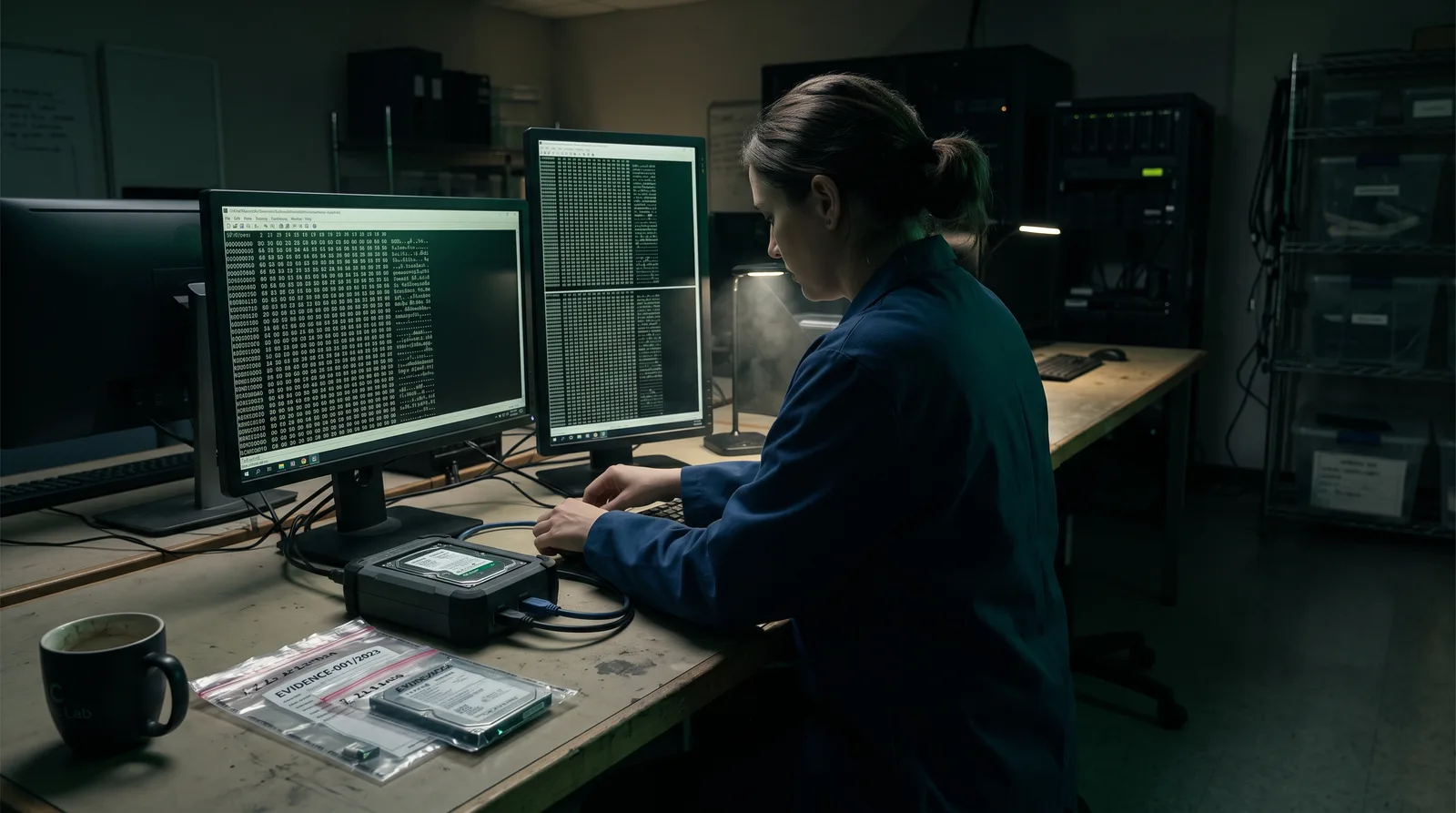
"In this field, your methodology is your credibility — so we build it right, from the first write-blocker to the final report."
— PROF. PETER OLU. OLAYIWOLA, Ph.D.
What you'll learn
What you'll be able to do
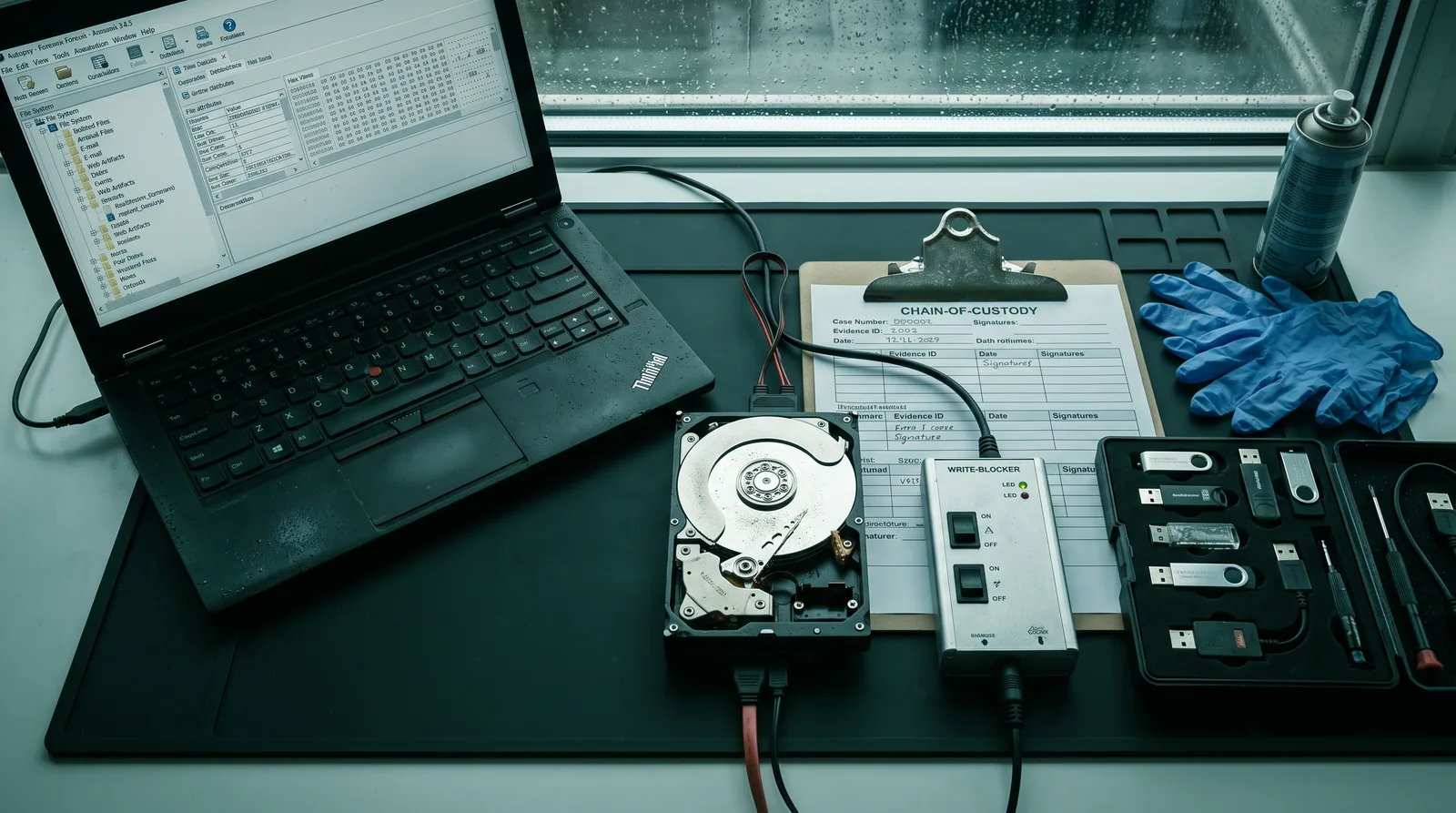
- Acquire and preserve digital evidence using industry-standard write-blockers and imaging tools like FTK Imager and dd
- Analyze file systems (NTFS, FAT32, ext4) to recover deleted files and reconstruct user activity timelines
- Perform memory forensics by dumping and parsing RAM with Volatility to identify running processes and malware artifacts
- Investigate network traffic captures in Wireshark to trace intrusion paths and exfiltrate indicators of compromise
- Conduct mobile device forensics on Android and iOS — extracting call logs, messages, and app data forensically
- Produce a court-admissible chain-of-custody documentation and a structured forensic investigation report
How it works
A school that adapts to you
This isn't a set of static videos. Every lesson is generated live and tuned to where you actually are.
We learn your level
A quick placement check tailors your starting point so you're never bored or lost.
Lessons adapt as you go
Each lesson is written for your pace and your goal, adjusting as your skills grow.
Your AI coach keeps you moving
Checkpoints, feedback, and gentle nudges turn progress into a real result.
The curriculum
What's inside your school
0 modules · 0 lessons

Foundations of Digital Forensics
Establishes the legal framework, investigator mindset, and core principles that underpin every forensic case.
- 1.1What Is Digital Forensics?Included
- 1.2Legal Frameworks and AdmissibilityIncluded
- 1.3The Forensic Investigation ProcessIncluded
- 1.4Chain of Custody: Principles and PracticeIncluded
- 1.5Setting Up Your Forensic Lab EnvironmentIncluded
Evidence Acquisition and Preservation
Teaches how to seize, image, and verify digital media without altering a single bit of evidence.
- 2.1Write Blockers: Hardware and SoftwareIncluded
- 2.2Disk Imaging with FTK ImagerIncluded
- 2.3Command-Line Imaging with dd and dcflddIncluded
- 2.4Hashing and Verifying Evidence IntegrityIncluded
- 2.5Documenting the Acquisition: Forms and LogsIncluded
File System and Storage Analysis
Develops skills to navigate and interrogate NTFS, FAT32, and ext4 file systems to recover data and reconstruct user activity.
- 3.1How File Systems Work: NTFS, FAT32, and ext4Included
- 3.2Recovering Deleted Files and Carving DataIncluded
- 3.3Analyzing Windows Artifacts: Registry, Prefetch, and LNK FilesIncluded
- 3.4Timeline Analysis and Reconstructing User ActivityIncluded
- 3.5Working with Autopsy: Full Case WalkthroughIncluded
Memory and Malware Forensics
Covers the acquisition and deep analysis of RAM to surface running processes, injected code, and malware artifacts.
- 4.1Why Memory Forensics MattersIncluded
- 4.2Capturing a Memory DumpIncluded
- 4.3Analyzing Memory with Volatility: Core CommandsIncluded
- 4.4Hunting Malware Artifacts in RAMIncluded
Network Forensics
Trains investigators to capture, filter, and dissect network traffic to trace intrusions and extract indicators of compromise.
- 5.1Network Forensics FundamentalsIncluded
- 5.2Capturing Traffic with Wireshark and tcpdumpIncluded
- 5.3Filtering and Dissecting Packets in WiresharkIncluded
- 5.4Tracing Intrusion Paths and Extracting IOCsIncluded
- 5.5Analyzing Logs: Firewall, DNS, and Web ServerIncluded
Mobile Device Forensics
Covers forensically sound extraction and analysis of data from Android and iOS devices.
- 6.1Mobile Forensics Overview: Android vs. iOSIncluded
- 6.2Extraction Methods: Logical, Physical, and File-SystemIncluded
- 6.3Extracting and Analyzing Android DataIncluded
- 6.4Extracting and Analyzing iOS DataIncluded
- 6.5Writing the Forensic Report and Closing the CaseIncluded
Who it's for
Is this you?

Aspiring forensic analysts
They want to break into digital forensics and need a structured, tool-grounded program that builds real investigative skills from the ground up.

IT administrators
They respond to security incidents at work and want the forensic methodology to properly examine, document, and report on what actually happened.
Law enforcement personnel
They encounter digital evidence in cases and need the technical knowledge to handle, extract, and document it in legally defensible ways.

Cybersecurity career-changers
They have a tech background but want to specialize — digital forensics and incident response is the career pivot, and this is the hands-on foundation they need.

Computer science graduates
They have academic theory but want applied forensic skills — working with Autopsy, Volatility, and Wireshark on real investigative workflows — to stand out to employers.

Paralegals & legal professionals
They work on cases involving digital evidence and want to understand exactly how that evidence is acquired, verified, and reported so they can work more effectively with expert witnesses.
Questions
Frequently asked
Your teacher
A note from your teacher

PROF. PETER OLU. OLAYIWOLA, Ph.D.
If you've landed here, you're probably somewhere I recognize. Maybe you're in IT and you've watched a security incident unfold with no clear idea of what to do after the breach. Maybe you're in law enforcement and digital evidence keeps showing up in your cases — evidence you know matters but don't yet have the tools to examine yourself. Or maybe you're starting fresh, you've read about digital forensics, and you want to do the work for real, not just read about it.
Whatever brought you here, I want you to know something: the gap between where you are right now and where a working forensic analyst stands is smaller than it looks. It's not a gap of raw intelligence. It's a gap of procedure. Digital forensics is a discipline built on repeatable, documented, methodical steps — and that means it can be taught, and it can be learned.
This course is structured the way a real investigation is structured. We start with the legal and procedural foundations — not as a dry prerequisite, but because understanding why chain of custody matters shapes how you handle every piece of evidence you'll ever touch. Then we move into acquisition: imaging drives, hashing artifacts, documenting everything. From there, we go deeper — into file systems, deleted data, Windows artifacts, memory dumps, network traffic, and mobile devices. Each module builds on the last. By the end, you're not completing exercises in isolation — you're running a case.
I designed this lab with one standard in mind: the work you do here should be defensible. That means defensible in a professional context, defensible in a courtroom, and defensible to yourself when you look at your report and know you followed the right process. I don't just show you the commands — I show you why each step exists, what goes wrong when it's skipped, and how to document it so your findings speak for themselves.
You don't need to be an expert to start. You need to be precise, patient, and willing to follow the procedure. If that's you, the lab is open. Let's get to work.
— PROF. PETER OLU. OLAYIWOLA, Ph.D.
Start your journey today
Get instant access — learn at your own pace with an AI coach in your corner.
$79/mo
Recurring billing · cancel anytime
Secure checkout · Instant access
- 6 modules, 29 lessons
- AI-adaptive lessons tuned to your level
- Quizzes & checkpoints to lock in progress
- Your own AI learning coach
- Learn on any device, at your pace
- Full access for as long as you're subscribed