Handwriting Analysis 101: Can You Really Tell a Forger from the Real Thing?
PROF. PETER OLU. OLAYIWOLA, Ph.D. · September 10, 2026 · 4 min read
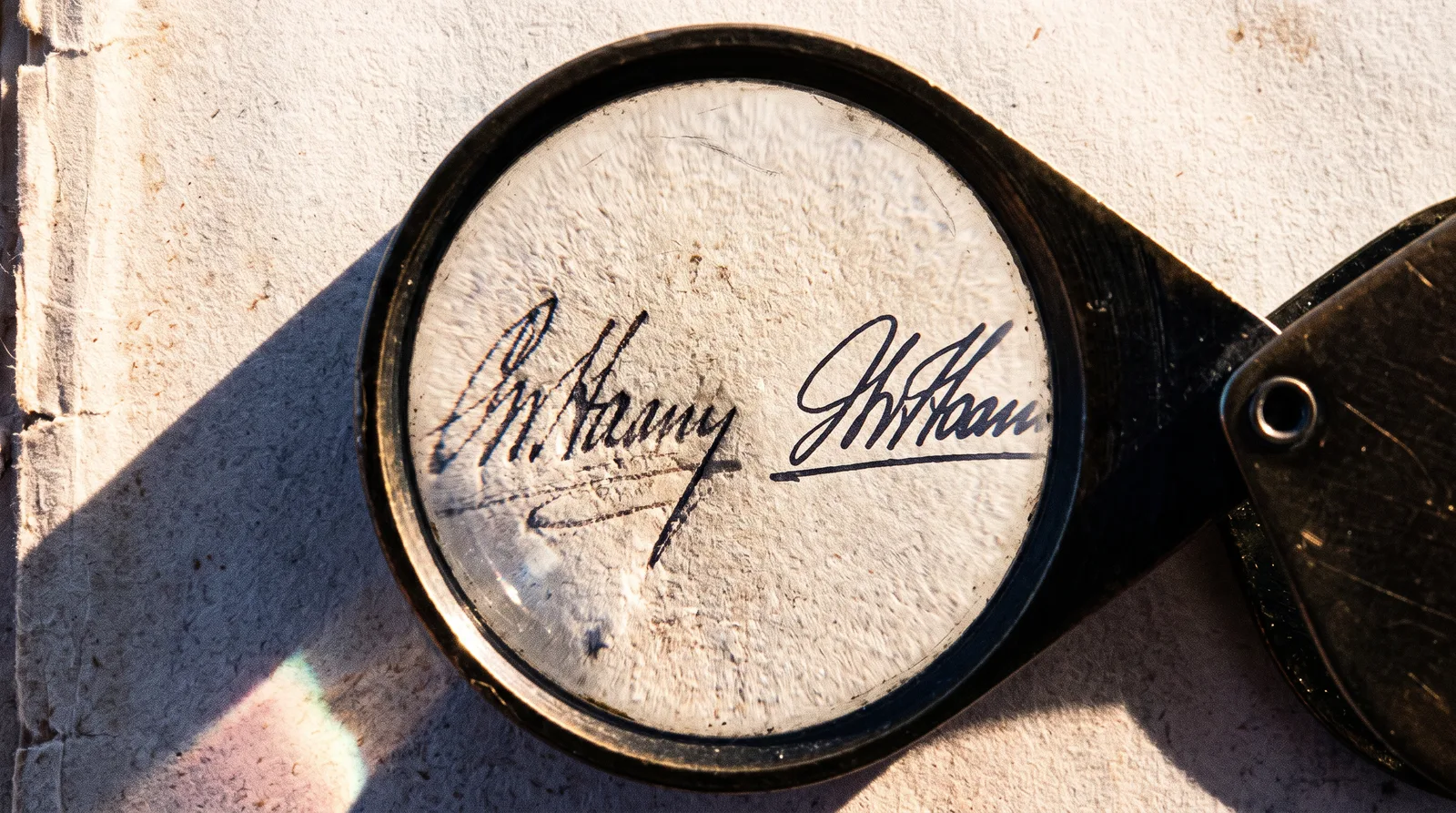
Most people assume that a good forger is almost impossible to catch. Copy the loops, match the slant, get the name to look roughly right — and you're done. But that assumption is precisely what makes forgers careless, and what makes questioned document examination so effective.
The truth is that handwriting is a deeply automatic motor skill. After years of practice, your hand executes letters through what neurologists call "motor memory" — a sequence of micro-movements you no longer consciously control. A forger, by definition, doesn't have your motor memory. They have your signature on a piece of paper and a pen in their hand. That gap between imitation and automaticity is where examiners live.
Here's what we actually look for.
Line Quality: The Forger's First Betrayal
Genuine handwriting flows. Even in a rushed or messy signature, the pen moves with consistent momentum — what examiners call line quality. Look at a clean photocopy of an authentic signature under magnification and you'll see smooth, confident strokes.
Now look at a traced or carefully drawn forgery. You'll almost always find:
- Tremor lines — tiny wavering along the stroke caused by the forger slowing down to stay "on track"
- Pen lifts — small breaks in what should be a continuous stroke, where the forger paused to reposition
- Blunt endings — strokes that stop flatly rather than tapering naturally, because the forger was watching the reference copy, not flowing from muscle memory
These aren't visible to the naked eye in a photocopy — but under a stereomicroscope or even a strong loupe, they're unmistakable.
Pen Pressure: What the Paper Remembers
Every stroke you make indents the paper with a unique pressure profile. Examiners call this pressure pattern, and it's one of the hardest things to fake.
In natural handwriting, pressure is heaviest on the downstrokes and lighter on the upstrokes — a rhythm driven by the mechanics of holding a pen. A forger concentrating on shape tends to apply uniform pressure throughout, because they're thinking about what the letter looks like, not how to write it.
You can test this yourself right now. Sign your name naturally. Then try to copy someone else's signature slowly and carefully. When you're done, hold each sheet at a low angle to a lamp and look at the surface indentations. Your own signature will show a distinct rhythm of deep and shallow grooves. The copy will likely feel more even — and more dead.
Examiners also use a technique called oblique lighting (raking light across the document surface at a sharp angle) to make pressure indentations visible without any chemical treatment at all.
Letterform Habits: The Details That Can't Be Borrowed
Beyond pressure, every writer has idiosyncratic letterform habits — small, consistent quirks in how they construct individual letters. Examiners catalog these by looking at:
- Entry and exit strokes — how a letter begins and ends before connecting to the next
- Loop proportions — the ratio of the upper loop height to the lower loop in letters like g, y, and f
- Connecting strokes — whether letters are joined in a single sweep or broken into components
- Retracing — whether the writer traces back over a previous stroke (common in letters like a and d) or lifts the pen
These habits are consistent across a writer's genuine samples and almost impossible to replicate without access to dozens of authentic exemplars written under different conditions — not just one reference signature.
What Forgers Get Right (and Why It Still Doesn't Save Them)
It's worth being honest: skilled forgers do get the visual impression right. A well-executed forgery can fool a bank teller, a notary, or a grieving family member sorting through a will. The overall silhouette of a signature can be matched.
But visual impression is not what a forensic examiner tests. We collect multiple genuine exemplars — ideally handwriting samples from different dates, contexts, and instruments — and we compare them against each other first to establish the range of natural variation within the genuine writer. Only then do we compare the questioned document against that baseline.
When the questioned document falls outside that natural variation in ways that cluster around the signs above — poor line quality, flattened pressure, borrowed but imperfectly executed letterforms — the evidence builds a case.
The Takeaway
Handwriting analysis isn't graphology or personality profiling. It's a forensic science grounded in observable, measurable physical evidence. And what makes it powerful is that the very act of slowing down to copy someone's handwriting produces the exact signals that betray the attempt.
If this kind of methodical, evidence-based analysis excites you — the way a single ink stroke on a questioned document can unravel an entire fraud — the Forensic Document Lab goes much deeper. We cover ink dating, indented writing recovery, typeface examination, and how to prepare findings that hold up under cross-examination in a US courtroom. The science is rigorous. The work is fascinating. And the skills are genuinely rare.